
Your monitors decide.Our platform checks the evidence first.
It maps the requirements that apply to each study and checks site documents against them as they arrive. Your monitors start from the evidence and decide what happens next.

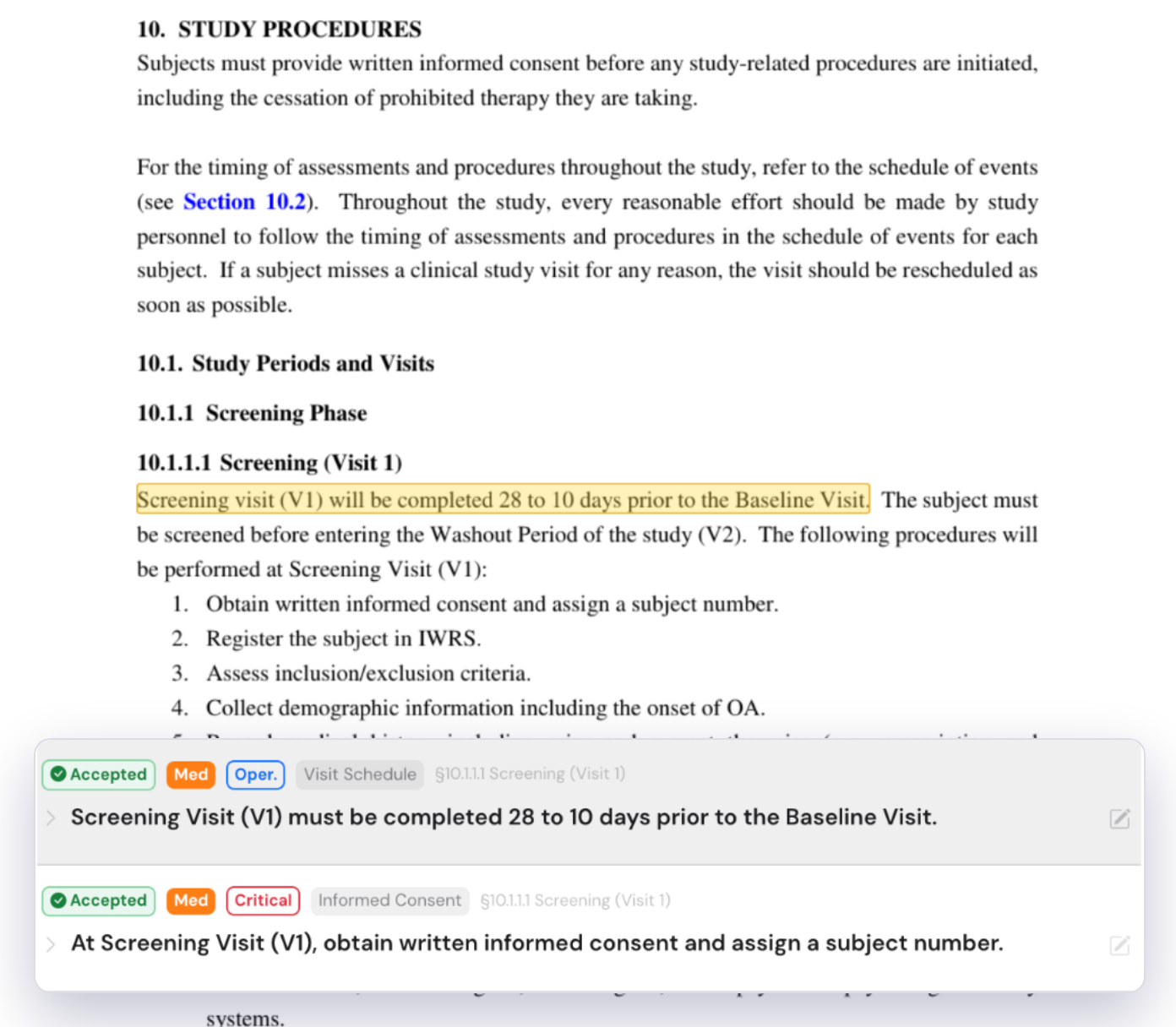
Requirements-driven source review for your monitoring teams.
Your monitors work across studies with different protocols, plans, and sponsor procedures. Loopa supports that work by bringing source evidence and mapped requirements together for assessment, alongside your existing monitoring approach.
In ACRO’s survey of new outsourced studies in 2025, roughly half used risk assessments, KRIs, centralized monitoring and remote monitoring, and most still had 100% SDR/SDV.
ACRO RBQM Survey Summary Report: 2025 new-study data, 4,296 outsourced studies from eight member CROs. FSP providers and specialty CROs were excluded.The platform maps, checks and compares. Your monitors decide.
Requirements Intelligence maps what applies to each study: protocol and study documents, plus the procedures agreed for it.
Requirements Intelligence
The platform: Maps requirements from the protocol, its amendments and the study documents, each tied to the sentence it came from.
Your monitors: Review each requirement and accept it.
Loops · cross-source verification
The platform: Checks documents as they arrive against those requirements and against other documents. Opens a Loop, with its evidence, when something is missing or does not match.
Your monitors: Confirm, override, record an observation or close each Loop. A Loop identifies a potential issue; it becomes a Finding only when a monitor confirms it.
EDC Verification
The platform: Compares site documents with what was entered in your EDC, read-only, where a connection exists.
Your monitors: Raise any query in your own systems. Loopa writes nothing to your EDC.
Each decision is recorded with who made it and when. The platform does not decide compliance.
How it worksOne screening form, from requirement to decision.
An illustrative example on synthetic data. The platform reads the form when the site uploads it, so the question can reach your monitor between visits.
-
The requirement
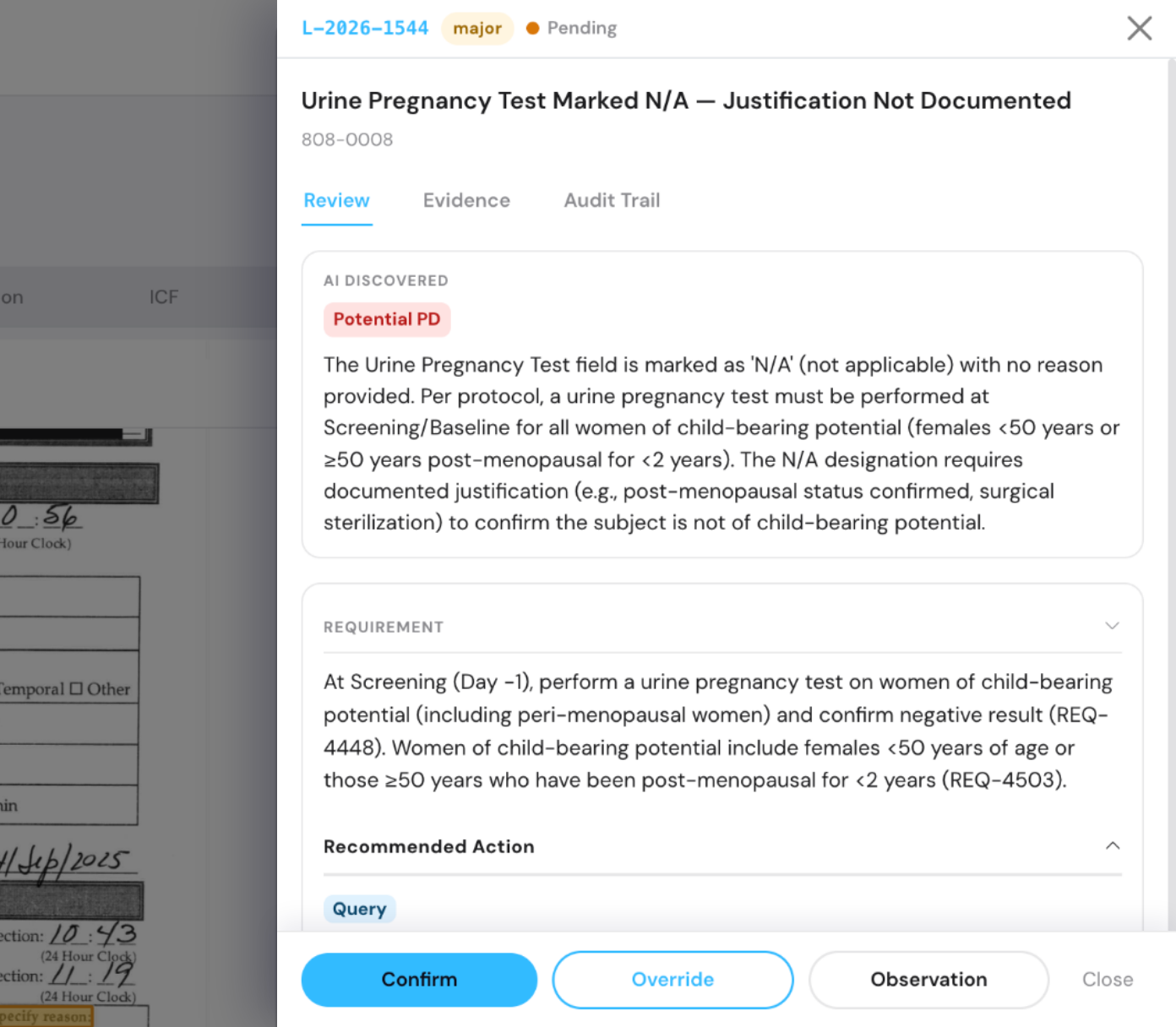
A pregnancy test is required at screening.
For women of child-bearing potential. Mapped from the protocol and accepted by a monitor.
-
On upload
The form says N/A, with no reason.
The platform reads the handwritten screening form and opens a Loop citing the page, the field and the requirement.
-
Between visits
Your monitor decides.
Your monitor checks the relevant records, assesses whether the requirement applies, and records the appropriate disposition. Further clarification may be needed before a Finding is confirmed.
-
Follow-up as needed
Your team raises any needed query.
Your team manages queries in its own systems. Where an EDC connection is available, EDC Verification compares source information with the EDC entry.
Monitor time can go to judgment and to sites instead of searching. What that is worth depends on how you contract monitoring, by the hour, by the unit or at a fixed fee, so we model it with you for each study.
Your teams. Your oversight. More visibility into the work.
Loopa complements your monitoring operation with study reporting and monitor-activity views. Your teams assess the evidence, manage follow-up, and retain ownership of monitoring decisions.
Fits your operating model
Use Loopa’s reporting alongside your existing monitoring procedures and management tools.
Evaluate the operational value
Assess source-review productivity and on-site time against your baseline, considering study scope and review quality.
How Loopa fits your operating model.
License the platform
Your monitors use it on your studies, under your procedures, and decide every Loop.
Beyond a license
If a study needs more than a license, tell us what you have in mind.
Here as a sponsor? For sponsors describes Loopa-led monitoring.
Loopa also provides monitoring directly to sponsors. We would rather you hear it from us, and we will answer any question about it before a partnership starts.
We agree with you which documents, versions and procedures apply to each study. Using the platform changes where your monitors start, not who signs off; which work instructions need updating is part of onboarding.
Where your EDC is connected, Loopa compares source information with EDC data through read-only access. Connection scope and permissions are agreed with the system owner. Other connection requests are assessed for technical feasibility and study needs.
IntegrationsDuring evaluation, we review access arrangements for your team, sponsors, and Loopa personnel, together with audit records and contractual terms for retention, return, and deletion.
Security and dataWe plan the first study with your monitoring and IT leads: the teams involved, source documents, submission workflow, and available connections.
Tell us how your monitoring teams work today.
A first conversation covers your studies, teams and systems, and which model fits. Bring your questions on data access, procedures and shared sponsors. We reply by email to arrange a time.